Who Owns AI Security When You Don't Have a Security Team
Most startups building with AI have shipped a feature that touches an LLM, a vector store, or an agent with tool access before they've had a single conversation about who is responsible for keeping it secure. The coding gets done. The security question gets deferred, not because anyone decided it wasn't important, but because nobody's job description says it's theirs.
This is different from traditional application security, where the gap is usually about resourcing. Most ten to thirty person engineering teams know they don't have a security engineer and know roughly what that means: slower patching, less formal review, more risk tolerance. AI security ownership is murkier. It's not clear whether it belongs to the person who wrote the prompt, the engineer who wired up the agent's tool permissions, the CTO who approved the architecture, or nobody at all until something breaks.
The problem
Ask five people at a typical AI-native startup who owns AI security, and you'll usually get five different answers, or a shrug. The person who built the RAG pipeline assumes someone reviewed it for prompt injection risk. The CTO assumes the engineer who shipped it followed reasonable practices. The founder assumes the CTO has it covered because that's what CTOs are for. Everyone is technically right that it's someone's job. No one is accountable for the fact that it isn't currently anyone's actual, assigned responsibility.
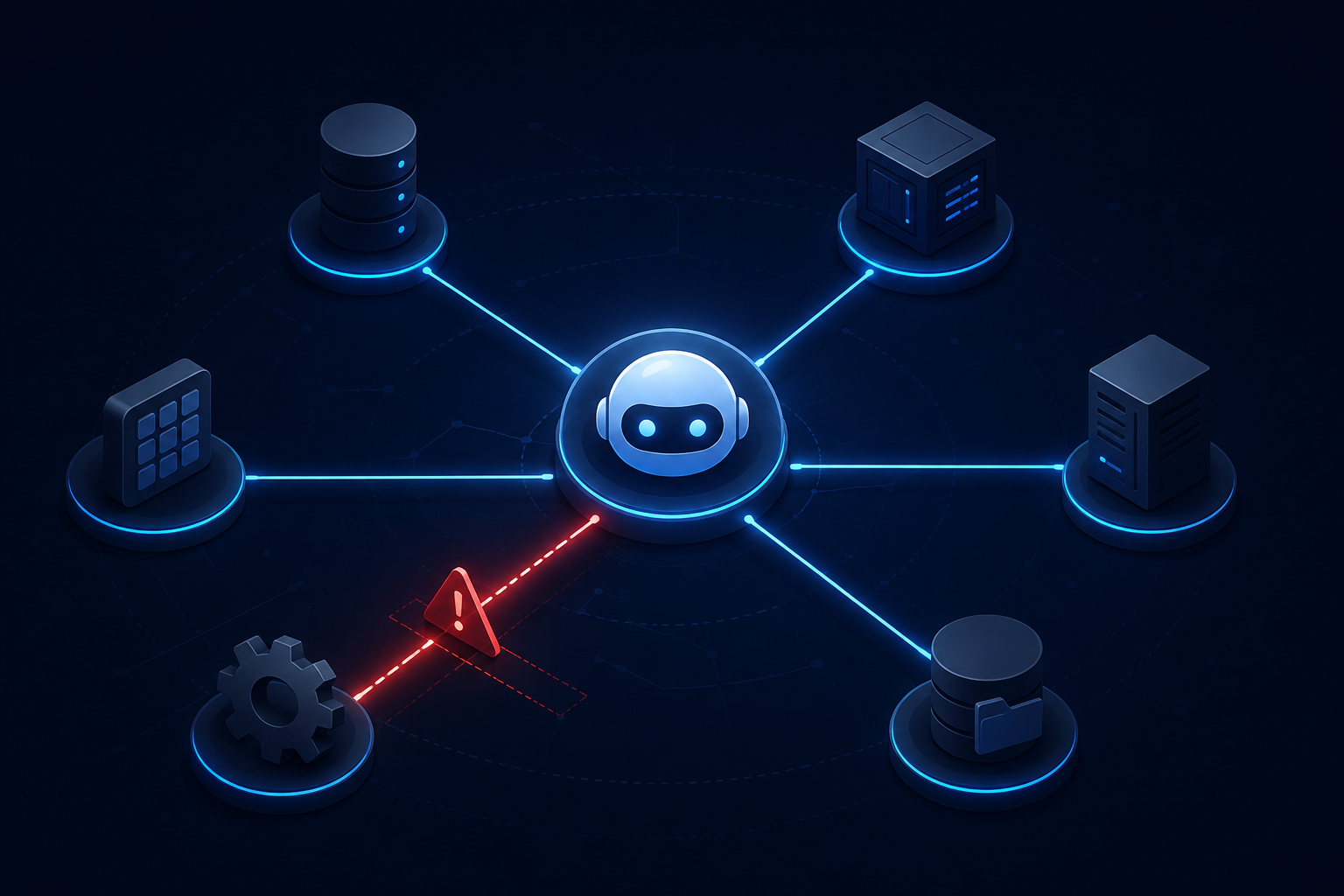
This gap tends to surface in the same three places: dependency and package trust (does anyone check what an AI coding assistant actually installed), agent permissions (does anyone review what an agent can touch before it ships), and context handling (does anyone think about what untrusted data an LLM will ingest and what it could do with it). These aren't edge cases. They're the default failure modes in agentic systems right now, and each one maps to a decision someone has to own, not just a technical control someone has to implement.
Why it happens
Three things make AI security ownership fall through the cracks in a way traditional infosec ownership usually doesn't.
First, the work is genuinely cross-functional. A prompt injection vulnerability in a RAG pipeline isn't purely an infrastructure problem or purely an application problem. It sits at the intersection of data handling, model behavior, and application logic, which means it doesn't map cleanly onto any one person's existing role.
Second, the skill is new enough that most engineering leaders haven't built the instinct for it yet. A senior backend engineer knows to worry about SQL injection because it's been part of the job for two decades. The same engineer may not think to ask whether a tool-calling agent can be manipulated into taking an unintended action, because that failure mode didn't exist in their training or their muscle memory.
Third, and this is the one founders underweight most, AI security work is easy to postpone without visible cost. A missing null check breaks the build. A missing security review doesn't break anything, until it does, and by then the team has shipped six more features on top of the same unreviewed foundation.
What it costs
The cost isn't usually a dramatic breach story, though those happen too. More often it's slower and less visible: technical debt that's specifically security debt, which is harder to justify fixing later because it never shows up on a roadmap and never has a champion. Engineers become the de facto owners of decisions they weren't equipped or authorized to make alone. And when something does go wrong, whether it's a leaked credential through an over-permissioned coding agent or a manipulated output from a poisoned context window, the postmortem reveals that three different people each assumed someone else was watching.
There's also a quieter cost in fundraising and enterprise sales conversations. Investors and enterprise buyers increasingly ask AI-native startups how they think about model and agent security. "We haven't formally assigned that yet" is a worse answer than a modest but real ownership structure, even one person spending four hours a week on it.
A framework for assigning ownership
The fix isn't hiring a security engineer before you can justify one. It's assigning a single accountable owner, even part-time, and giving that person three concrete responsibilities instead of a vague mandate.
Pick one accountable person, not a committee. This is usually the most senior engineer with security instincts, or the CTO directly in a smaller team. The title doesn't matter. What matters is that when someone asks "who signed off on this agent's permissions," there's one name, not a diffuse sense that the team handled it.
Define the minimum review surface. Rather than trying to cover everything, the owner should have a short, explicit checklist tied to your actual stack: dependency provenance for anything an AI coding assistant suggests, a permissions review before any agent gets write access or tool-calling ability, and a data-handling check for any pipeline that feeds untrusted content into a model's context window. Three checks, consistently applied, beat an aspirational full security program that never gets built.
Put a review gate before agent capability expansion, not after. The recurring pattern across supply chain, coding agent, and RAG vulnerabilities is the same: the risk gets introduced when scope expands, not when the system is first built. Anytime an agent gains a new tool, a new data source, or broader permissions, that's the trigger point for the owner to look at it, not a quarterly audit cycle that misses the moment the risk actually changed.
Applying this at a real team
At a ten person team, this might mean the CTO spends two hours every other week walking through what shipped and what changed in agent permissions or data sources. At thirty people, it might be a senior engineer with fifteen percent of their time protected for exactly this, reporting findings to the CTO monthly. Neither requires a security hire. Both require the founder to say out loud, in a meeting people actually attend, that this is now someone's job and not an ambient hope.
The teams that get this right treat AI security ownership the way they'd treat on-call rotation or incident response: not glamorous, not something anyone volunteers for, but explicitly assigned, reviewed, and taken seriously enough that everyone knows exactly who to ask.